
Confused about saving account vs current account and not sure which one is right for you? You are not alone. Whether you are an individual managing personal finances, a freelancer receiving client payments, a small business owner, or a startup founder, choosing the right type of bank account is one of the most important financial decisions you can make.
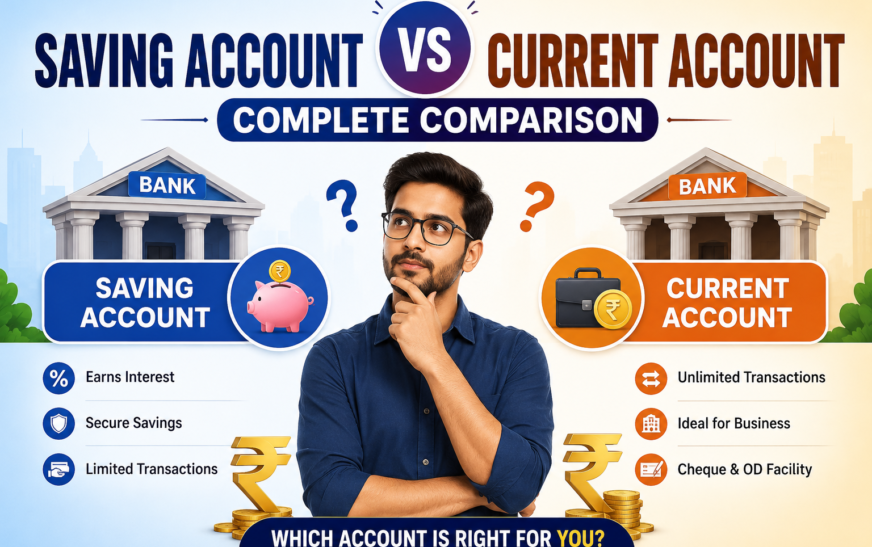
While both saving accounts and current accounts are offered by every bank in India, they serve completely different purposes. A savings account is designed to help you save money and earn interest, perfect for personal use. A current account is designed for high volume business transactions with unlimited deposits and withdrawals but with little to no interest.
Picking the wrong account can cost you money in penalties, missed interest, transaction limits, or unnecessary fees. In this complete guide, you will discover everything you need to know about saving account vs current account, their features, charges, interest rates, eligibility, and how to choose the right one for your needs. Let us dive in.
What Is a Savings Account?
A savings account is a deposit account offered by banks to individuals for safely keeping their money while earning interest on the balance. It is designed for personal use, not business transactions.
Key features:
- Earns interest on the balance (typically 2.5 percent to 7.5 percent per annum)
- Designed for individuals, students, families, and salaried professionals
- Comes with a debit card, cheque book, mobile banking, and UPI access
- Has restrictions on the number of monthly transactions
- Requires minimum balance maintenance (zero in some accounts)
Savings accounts are perfect for your day to day finances, emergency funds, and short term goals. If you want to maximize interest, check our complete guide on the best bank for savings account in India to find the highest paying options.
What Is a Current Account?
A current account is a deposit account designed for businesses, entrepreneurs, traders, freelancers, professionals, and any entity with high volume daily transactions. It supports unlimited deposits and withdrawals but typically earns no interest.
Key features:
- Supports unlimited transactions without restrictions
- Offers higher transaction limits and overdraft facilities
- Designed for businesses, firms, companies, and professionals
- Comes with chequebooks, demand drafts, business debit cards, and online banking
- No interest or very minimal interest on the balance
- Higher minimum balance requirements compared to savings accounts
Current accounts are perfect for managing day to day business finances, paying suppliers, receiving customer payments, and handling bulk transactions.
Saving Account vs Current Account: Key Differences
Here is a complete comparison of saving account vs current account across the most important parameters.
1. Purpose
Savings Account: Designed for individuals to save money, manage daily expenses, and earn interest.
Current Account: Designed for businesses and professionals to handle frequent, high volume transactions.
2. Who Can Open
Savings Account: Individuals, salaried employees, students, senior citizens, joint account holders, and minors (through guardians).
Current Account: Sole proprietors, partnerships, LLPs, private limited companies, public companies, trusts, societies, freelancers, traders, and any business entity.
3. Interest Rate
Savings Account: Earns interest between 2.5 percent to 7.5 percent per annum based on the bank and balance tier. Some small finance banks offer up to 8 percent on high balance slabs.
Current Account: Typically earns zero interest. Some banks offer a token 0.5 to 1 percent on average quarterly balance.
4. Minimum Balance Requirements
Savings Account: Ranges from zero balance (Kotak 811, SBI BSBDA) to 25,000 rupees AMB (premium accounts).
Current Account: Usually higher, ranging from 5,000 rupees to 1 lakh rupees AMB or more, depending on the bank and account type.
5. Transaction Limits
Savings Account: Typically allows around 50 free transactions per month (varies by bank). Beyond this, charges may apply. Cash deposit and withdrawal limits also apply.
Current Account: Allows unlimited transactions with no restrictions, perfect for businesses processing dozens or hundreds of transactions daily.
6. Overdraft Facility
Savings Account: Usually not available. Some premium accounts may offer a small overdraft as a feature.
Current Account: Overdraft facility is one of the biggest benefits. Businesses can withdraw more than their balance up to a sanctioned limit to meet short term cash flow needs.
7. Cheque Book
Savings Account: Free chequebooks with limited number of leaves per year. Charges apply for extra books.
Current Account: Free cheque books with significantly higher number of leaves, plus easy access to demand drafts and pay orders.
8. Tax Implications
Savings Account: Interest up to 10,000 rupees per year (50,000 for senior citizens) is tax exempt under Section 80TTA / 80TTB. Beyond that, interest is taxable as per slab.
Current Account: No interest, so no specific tax exemption applies. However, business income from the account is subject to standard business taxation rules.
9. Account Opening Documents
Savings Account: Aadhaar, PAN, address proof, photographs, and basic KYC.
Current Account: PAN, GST registration, business address proof, partnership deed or company incorporation documents, business registration certificate, and more.
10. Mobile and Internet Banking
Savings Account: Full mobile and internet banking with UPI, NEFT, RTGS, IMPS, bill payments, and investments.
Current Account: Full digital banking with bulk payment options, multi user access, integration with accounting tools like Tally and Zoho Books, and tax payment features.
Quick Comparison Table: Saving Account vs Current Account
For a quick overview, here are the key differences side by side.
Purpose: Savings → Personal saving | Current → Business operations
Interest: Savings → 2.5% to 7.5% | Current → Zero or minimal
Minimum Balance: Savings → Zero to 25,000 rupees | Current → 5,000 to 1 lakh+
Transactions: Savings → Limited | Current → Unlimited
Overdraft: Savings → Usually not available | Current → Available
Account Holders: Savings → Individuals | Current → Businesses
Documents: Savings → Simple KYC | Current → Detailed business documents
Best For: Savings → Salary, expenses, emergencies | Current → Business cash flow
Types of Savings Accounts in India
Indian banks offer several types of savings accounts.
Regular Savings Account: Standard accounts for everyday personal banking with average monthly balance requirements.
Zero Balance Savings Account: No minimum balance required. Examples include Kotak 811, SBI BSBDA, and RBL Digital.
Salary Account: Zero balance accounts opened through employer tie ups with premium perks. Check our guide on which bank is best for salary account in India for more.
Senior Citizen Savings Account: Special benefits including higher interest, priority service, and free health insurance.
Women’s Savings Account: Tailored accounts with cashback, lifestyle offers, and discounts for women.
Minor Savings Account: For children below 18, opened with parent or guardian as joint holder.
Premium Savings Account: For high net worth customers with relationship managers, lounge access, and exclusive perks.
Digital Savings Account: Fully online accounts opened via video KYC with no branch visit required.
Types of Current Accounts in India
Indian banks also offer several variants of current accounts to suit different business needs.
Standard Current Account: Basic accounts for small businesses with moderate transaction volumes.
Premium Current Account: For mid sized businesses with higher transaction limits and added perks like dedicated relationship managers.
Foreign Currency Current Account (EEFC/FCNR): For businesses dealing in foreign currency or exporters and importers.
Single Holder Current Account: Best for sole proprietors and freelancers.
Joint Current Account: For partnerships and joint ventures.
Company Current Account: For private limited and public limited companies with multi user access.
NRI Current Account: For non resident Indians running businesses or earning income from India.
Zero Balance Current Account: Limited offering by some banks for startups and new businesses.
Saving Account vs Current Account: Charges to Watch
Both accounts come with their own set of charges. Here is what to compare.
Savings Account Charges
- Non maintenance charges: If your balance falls below the minimum required AMB. Ranges from 150 to 600 rupees per month.
- Debit card annual fees: 100 to 500 rupees for standard cards, 1,000+ for premium cards.
- Cheque book charges: First book usually free, then 50 to 300 rupees per book.
- ATM transaction limits: Free ATM transactions are limited per month at other banks’ ATMs.
- SMS alert charges: 15 to 60 rupees per quarter.
Current Account Charges
- Non maintenance charges: Usually higher than savings accounts, can range from 750 to 5,000 rupees per quarter for premium accounts.
- Cash handling charges: Cash deposits and withdrawals beyond a certain limit attract charges of 1 to 2 rupees per 1,000 rupees handled.
- Transaction charges: Bulk transfers, NEFT, RTGS, and DDs may have higher charges than savings accounts.
- Annual maintenance charges: Some premium current accounts charge yearly fees of 1,000 to 5,000 rupees.
Who Should Open a Savings Account?
A savings account is the right choice for you if:
- You are a salaried employee or earn a regular monthly income
- You want to safely save money and earn interest
- Your monthly transactions are limited (under 50 to 60 transactions)
- You need access to UPI, debit card, and online banking for personal expenses
- You are a student, homemaker, retiree, or senior citizen
- You want to manage daily expenses, emergency funds, and short term goals
If you want to maximize your savings, also explore our guide on banks that give higher interest rate in India for high yield options.
Who Should Open a Current Account?
A current account is the right choice for you if:
- You run a business (sole proprietorship, partnership, LLP, or company)
- You are a freelancer or professional with high transaction volumes
- You need to make and receive frequent payments to suppliers and customers
- You need overdraft facility for short term cash flow needs
- You are an importer, exporter, or trader handling foreign currency
- You want unlimited transactions without monthly limits
- You need to integrate banking with accounting software like Tally or Zoho Books
For freelancers and small businesses, having both a savings and current account is often the smartest strategy.
How to Open a Savings Account in India
Opening a savings account is simple and can usually be done online in minutes.
Step 1: Choose a bank based on interest rate, features, fees, and digital banking quality.
Step 2: Visit the bank’s website, app, or branch.
Step 3: Fill in the application form with your personal details.
Step 4: Submit KYC documents (Aadhaar, PAN, photo, address proof).
Step 5: Complete e KYC through video verification or branch visit.
Step 6: Make the initial deposit (if required).
Step 7: Receive your debit card, cheque book, and access to mobile banking.
You can open many top digital savings accounts entirely online in less than 10 minutes. Examples include Kotak 811, SBI Insta Plus, ICICI iMobile Pay, and IDFC First Bank Savings.
How to Open a Current Account in India
Opening a current account requires more documentation due to business compliance needs.
Step 1: Decide on the type of current account based on your business structure.
Step 2: Choose a bank based on charges, transaction limits, overdraft offerings, and digital features.
Step 3: Gather required documents including:
- PAN card (personal and business)
- GST registration (if applicable)
- Business address proof
- Business registration certificate
- Partnership deed or Memorandum of Association (MoA)
- Board resolution (for companies)
- ID and address proof of authorized signatories
- Recent photographs
- Bank statement of existing accounts (if applicable)
Step 4: Visit the bank branch or apply online.
Step 5: Submit documents and complete KYC verification.
Step 6: Deposit the initial amount and start using your current account.
Top banks offering business friendly current accounts include HDFC Bank, ICICI Bank, SBI, Axis Bank, IDFC First Bank, and RBL Bank.
Can You Have Both a Savings Account and Current Account?
Yes, absolutely. In fact, most business owners, freelancers, and professionals are recommended to maintain both account types.
Why have both:
- Keep personal and business finances separate for easier accounting and taxation
- Earn interest on personal savings while running business through current account
- Build a clean credit history for both personal and business loans
- Simplify ITR filing and avoid mixing income sources
Smart strategy:
- Use savings account for personal salary, monthly expenses, savings, and investments
- Use current account for all business income, payments, and tax related transactions
- Transfer your business profit or freelancing earnings into your savings account at month end
Tax Implications: Saving Account vs Current Account
Tax treatment differs significantly between the two account types.
Savings Account Tax Rules
- Interest earned is taxable as “Income from Other Sources”
- Up to 10,000 rupees of interest per year is exempt under Section 80TTA (50,000 rupees for senior citizens under 80TTB)
- TDS is not deducted by banks on savings interest (you must self report)
- Cash deposits above 10 lakh rupees per year are reported to the Income Tax Department
Current Account Tax Rules
- No interest, so no specific Section 80TTA benefit
- All business transactions are part of your business income or expenses
- GST applies on business transactions and services
- Cash deposits above 50 lakh rupees per year in a current account are reported to the Income Tax Department
- ITR must include current account income under business income heads
For full tax planning, visit the Income Tax Department of India website.
Common Mistakes to Avoid With Bank Accounts
Avoid these traps to make the most of your accounts.
Using savings account for business. Many freelancers and small business owners use their personal savings account for business transactions. This causes accounting nightmares during ITR filing and limits your transaction volume.
Choosing low interest banks. A 5 percent vs 7 percent difference on a 1 lakh balance means 2,000 rupees per year in lost income. Always compare savings account interest rates.
Ignoring AMB rules. Non maintenance fees can wipe out months of interest earnings. Either maintain the required balance or switch to a zero balance account.
Maintaining multiple unused accounts. Each account adds balance requirements, fees, and clutter. Consolidate to 2 or 3 accounts max.
Not separating personal and business money. Mixing the two creates confusion, tax issues, and loan application problems.
Skipping mobile and internet banking. Modern accounts offer powerful digital features. Skipping them means missing instant transfers, easy bill payments, and security alerts.
For more smart money habits, explore our guide on 15 personal finance tips to build long term financial discipline.
Tips to Choose the Right Account
Use these tips to choose the right account for your needs.
Match the account to your purpose. Personal finances → Savings. Business → Current. Both? Have both.
Compare interest rates. For savings, look for high interest banks like IDFC First, AU Small Finance, RBL, and DCB.
Check digital features. Top mobile apps, instant transfers, UPI integration, and virtual debit cards matter today.
Review charges carefully. Look for non maintenance fees, debit card fees, cheque book fees, and transaction charges.
Consider customer service. Strong customer support saves you time and stress when issues arise.
Check branch and ATM network. If you need cash often, choose a bank with strong presence in your area.
Track using apps. Use the best apps for managing personal money in India to monitor all your accounts in one place.
How to Switch From Savings to Current Account
If your transaction volume has grown beyond personal use, it is time to open a current account.
Step 1: Keep your savings account active for personal needs.
Step 2: Open a current account at the same or a different bank suited for your business type.
Step 3: Update your business clients, vendors, and tax accounts with your new current account details.
Step 4: Use the savings account only for personal transactions and the current account only for business.
Step 5: Track both accounts separately for clean accounting and easier ITR filing.
Frequently Asked Questions (FAQs)
What is the main difference between saving account and current account?
The main difference is purpose. A savings account is designed for individuals to save money and earn interest, while a current account is designed for businesses to handle unlimited daily transactions. Savings accounts earn 2.5 percent to 7.5 percent interest, while current accounts typically earn no interest.
Can a salaried employee open a current account?
Yes, a salaried employee can open a current account if they need it for business or freelance work alongside their job. However, current accounts are not suitable for receiving regular salary, which should go into a salary account or savings account.
Which is better for freelancers, savings or current account?
For freelancers handling moderate transaction volumes, a savings account is often sufficient. However, if your freelancing income is substantial or includes multiple clients, GST registration, or international payments, a current account makes more sense for cleaner business accounting and unlimited transactions.
Do savings accounts have transaction limits in India?
Yes, most savings accounts allow around 50 free transactions per month including ATM withdrawals, cheque payments, and online transfers. Beyond this, banks may charge per transaction. Cash deposit and withdrawal limits also apply based on your account type.
Is interest earned on savings account taxable?
Yes, interest earned on a savings account is taxable as “Income from Other Sources.” However, up to 10,000 rupees of interest is exempt under Section 80TTA for general taxpayers and up to 50,000 rupees for senior citizens under Section 80TTB.
Can I get a debit card with a current account?
Yes, most current accounts come with a business debit card. Many premium current accounts also include corporate credit cards, lounge access, and reward programs designed for business spending.
Do current accounts earn interest?
Most current accounts in India do not earn interest. Some banks offer a token interest of 0.5 to 1 percent on the average quarterly balance, but this is much lower than savings accounts. The trade off is unlimited transactions and overdraft facilities.
What documents are needed for a current account?
Current account documents include PAN card (personal and business), GST registration (if applicable), business address proof, business registration certificate, partnership deed or MoA, board resolution (for companies), and ID/address proof of all authorized signatories.
Can I have both a savings account and a current account?
Yes. Most business owners, freelancers, and professionals are recommended to have both. Use the savings account for personal finances and salary, and the current account for all business related income and expenses.
Are current accounts safe in India?
Yes. Current accounts at scheduled banks regulated by the Reserve Bank of India (RBI) are safe. Deposits up to 5 lakh rupees per depositor per bank are insured by DICGC. For businesses holding large balances, spreading funds across multiple banks reduces concentration risk.
Final Thoughts
Understanding saving account vs current account is one of the most important steps to building strong financial discipline, whether you are an individual or a business owner. While both account types are essential parts of the Indian banking system, they serve completely different purposes and choosing the right one for your needs can save you thousands of rupees in fees and missed interest each year.
For personal needs like salary, monthly expenses, savings, and investments, a savings account is the smart choice. For running a business, accepting payments, and handling high volume transactions, a current account is the right fit. If you do both, having a savings account for personal finances and a current account for business is the ideal setup.
Always compare features, interest rates, charges, and digital banking quality before opening any account. Modern banking is highly competitive, with many top banks offering attractive savings rates and feature rich current accounts. Use the right account for the right purpose, track everything with the best apps for managing personal money in India, and pair your banking with smart investment options for beginners in India to build long term wealth.
Which account type fits your needs best? Choose wisely, open the right account today, and share your experience in the comments below.
Disclaimer: Interest rates, account features, and charges mentioned in this article are based on the most recent publicly available data at the time of writing and may change without notice. Always verify the latest details directly from official bank websites or visit the RBI website before opening an account. This article is for informational purposes only and does not constitute financial or banking advice. Consult a SEBI registered financial advisor or CA for personalized guidance.