
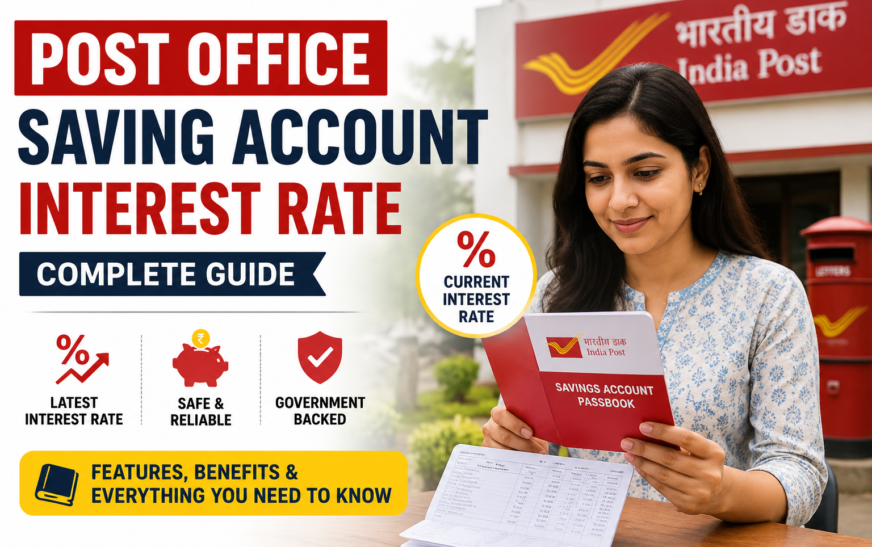
Looking for the latest post office saving account interest rate and want to know if it is a good option for your money? You are in the right place. The Post Office Savings Account (POSA) is one of the oldest, safest, and most trusted savings instruments in India, operated by the Department of Posts under the Government of India. With over 1.5 lakh post offices across the country, it remains a go to option for crores of Indians, especially in rural and semi urban areas.
Unlike many private banks where interest rates fluctuate based on the bank’s policies, the post office savings account offers a stable, government backed interest rate that is revised quarterly by the Ministry of Finance. The current rate is competitive compared to most large public and private sector bank savings accounts, making the post office savings account a reliable choice for safe banking.
In this complete guide, you will discover the current post office saving account interest rate, key features, eligibility, tax benefits, account opening process, comparison with bank accounts, and smart tips to maximize your returns. Let us dive in.
What Is a Post Office Savings Account?
A Post Office Savings Account (POSA) is a savings account offered by the Department of Posts (India Post) under the Government of India’s small savings scheme. It works very similarly to a regular bank savings account but is operated through post offices and India Post Payments Bank (IPPB).
Key purpose: To provide a safe, government backed savings option for individuals across India, especially in areas with limited bank access.
Operated by: Department of Posts (India Post), under the Ministry of Communications.
Backed by: Full sovereign guarantee from the Government of India.
This makes the post office savings account one of the safest places to park your money, with zero capital risk.
Current Post Office Saving Account Interest Rate
The current post office saving account interest rate is 4 percent per annum.
Important points about the interest rate:
- The rate is fixed at 4 percent per annum at present
- Interest is calculated on the monthly balance and credited annually at the end of the financial year
- The rate has remained stable at 4 percent for several years
- Like other small savings scheme rates, this rate is reviewed quarterly by the Government of India
While 4 percent is lower than what some private banks like IDFC First Bank, AU Small Finance Bank, or RBL Bank offer on their savings accounts, the trust, accessibility, and government backing of POSA make it attractive for many savers, especially in rural and semi urban India.
If you want to compare with private bank savings accounts, check our complete guide on the best bank for savings account in India for higher interest options.
How Is Post Office Savings Account Interest Calculated?
The interest on the post office savings account is calculated using a specific method.
Calculation method:
- Interest is calculated on the minimum balance maintained between the 10th and the last day of each month
- The total annual interest is the sum of all monthly interest calculations
- The interest is credited to your account at the end of the financial year (March 31st)
Formula:
Monthly Interest = (Minimum Balance Between 10th and Last Day of Month) × (Annual Interest Rate ÷ 12)
Example:
If your minimum monthly balance between the 10th and the end of the month is 10,000 rupees and the interest rate is 4 percent per annum:
Monthly Interest = 10,000 × (4 ÷ 12 ÷ 100) = 33.33 rupees
Annual Interest = 33.33 × 12 = 400 rupees (assuming the same balance every month)
Pro tip: To maximize interest, keep your minimum balance higher between the 10th and the end of the month rather than withdrawing right after a deposit.
Key Features of Post Office Savings Account
The post office savings account comes with several attractive features.
1. Low Minimum Balance Requirement
You can open a post office savings account with just 500 rupees, and the minimum balance to keep the account active is also 500 rupees. This makes it one of the most accessible savings accounts in India.
2. Government Guarantee
Since the account is backed by the Government of India, your money is fully secure with sovereign guarantee. This is even stronger protection than the DICGC’s 5 lakh rupees deposit insurance.
3. Cheque Book Facility
You can request a free cheque book upon account opening or anytime later. Cheque books make it easy to handle large transactions and payments.
4. ATM and Debit Card
Post office accounts now come with a debit cum ATM card that works at ATMs across India. This adds modern banking convenience to your traditional post office account.
5. Mobile and Internet Banking
Through India Post Payments Bank (IPPB), account holders can now access mobile banking, internet banking, UPI, and bill payment services right from their phones.
6. Joint Account Facility
You can open a single account or jointly with up to 3 other adults. Joint accounts are useful for couples, parents and children, or shared family savings.
7. Nomination Facility
You can nominate up to 4 people who will receive the account balance in case of your death. Always update nominations to avoid legal complications.
8. Multiple Account Types
You can open accounts in the names of minors (through guardian), illiterate persons, and even physically handicapped individuals with specific provisions.
9. Easy Withdrawals
Withdrawals can be made through cheques, ATMs, withdrawal slips, or money orders. There is no restriction on the number of withdrawals (subject to balance maintenance).
10. Tax Benefits
Interest earned on post office savings accounts qualifies for tax deduction under Section 80TTA. Senior citizens get even higher benefits under Section 80TTB.
For more smart tax planning, also check our complete guide on 15 personal finance tips.
Eligibility for Post Office Savings Account
The eligibility criteria for opening a post office savings account are straightforward.
Eligible to open the account:
- Any individual Indian citizen above 10 years of age
- Minors (below 18 years) with a guardian
- A guardian on behalf of a minor below 10 years
- Two or three adults jointly
- Illiterate persons (with proper identification)
- Persons of unsound mind (through guardian)
Not eligible:
- Non Resident Indians (NRIs)
- Hindu Undivided Families (HUFs)
- Foreign nationals
You will need to submit valid KYC documents including Aadhaar, PAN, address proof, and recent photographs at the time of opening.
Post Office Saving Account Tax Benefits
The post office savings account offers attractive tax benefits.
Section 80TTA Deduction
Under Section 80TTA of the Income Tax Act, interest earned up to 10,000 rupees per financial year on savings accounts (including post office) is exempt from tax.
Section 80TTB for Senior Citizens
Senior citizens (60 years and above) get a higher deduction of up to 50,000 rupees on interest earned from savings accounts, FDs, and recurring deposits combined under Section 80TTB.
No TDS on Post Office Savings Account Interest
Unlike bank FDs, TDS is not applicable on post office savings account interest. This means the bank does not deduct tax at source, but you must still declare the interest income in your ITR.
For detailed tax filing rules, visit the Income Tax Department of India website.
How to Open a Post Office Savings Account
Opening a post office savings account is simple and can be done at any post office across India.
Step 1: Visit Your Nearest Post Office
Find your nearest post office through the India Post website or use the IPPB mobile app.
Step 2: Collect the Application Form
Ask for the SB 3 (Account Opening Form) at the post office counter, or download it from the India Post website.
Step 3: Fill in the Application Form
Provide the following information:
- Full name as per PAN and Aadhaar
- Date of birth
- Address
- Contact details
- Mode of operation (single, joint, etc.)
- Initial deposit amount
- Nominee details
Step 4: Submit Required Documents
The standard documents needed are:
- Identity proof: Aadhaar card, PAN card, Voter ID, or passport
- Address proof: Aadhaar, utility bill, rental agreement, or passport
- Two passport size photographs
- PAN card (mandatory for opening the account)
- Aadhaar card (mandatory for KYC)
All documents must be self attested.
Step 5: Make Initial Deposit
Deposit at least 500 rupees as the opening amount. This can be done in cash, by cheque, or via demand draft.
Step 6: Receive Passbook
Once your account is opened, you will receive a passbook with all your account details. Keep it safe for future transactions.
Step 7: Activate Mobile and Internet Banking (Optional)
Visit your post office or use the IPPB app to activate mobile banking, UPI, and internet banking on your account.
Post Office Saving Account vs Bank Savings Account
A common question is whether the post office savings account is better than a bank savings account. Here is a fair comparison.
Interest Rate
- Post Office: 4 percent per annum
- Public Sector Banks (SBI, PNB): 2.5 to 3 percent per annum
- Private Banks (HDFC, ICICI, Axis): 2.5 to 3 percent per annum
- Top Private Banks (IDFC First, Kotak): 3 to 7 percent per annum on tiered slabs
- Small Finance Banks (AU, Equitas, RBL): Up to 7 to 8 percent per annum
Safety
- Post Office: Full government guarantee (sovereign)
- Banks: DICGC insurance up to 5 lakh rupees per depositor per bank
Accessibility
- Post Office: 1.5 lakh+ branches, strong rural presence
- Banks: Strong urban presence, growing rural reach
Digital Banking
- Post Office: Available through IPPB app, slowly improving
- Banks: Highly developed mobile apps and internet banking
Minimum Balance
- Post Office: 500 rupees
- Banks: Varies from zero to 25,000 rupees AMB
For more savings account options, check our guide on saving account vs current account to understand which account type is right for you.
Post Office Savings Account vs Other Post Office Schemes
The post office savings account is just one of many products offered by India Post. Here is how it compares with other small savings schemes.
Post Office Savings Account (POSA): 4 percent per annum, full liquidity, day to day banking.
Post Office Recurring Deposit (RD): 6.7 percent per annum, 5 year tenure, monthly deposits.
Post Office Time Deposit (TD): 6.9 to 7.5 percent per annum, fixed tenure of 1, 2, 3, or 5 years.
Senior Citizen Saving Scheme (SCSS): 8.2 percent per annum, for senior citizens. Learn more in our complete Senior Citizen Saving Scheme guide.
Public Provident Fund (PPF): 7.1 percent per annum, 15 year lock in, tax free returns.
Sukanya Samriddhi Yojana (SSY): 8.2 percent per annum, for girl child, tax free returns.
National Savings Certificate (NSC): 7.7 percent per annum, 5 year lock in, tax saving.
For a complete comparison of all post office schemes, check our detailed guide on saving schemes in post office.
Tips to Maximize Returns from Your Post Office Savings Account
Use these smart strategies to make the most of your post office savings account.
Keep higher balance between the 10th and end of the month. Since interest is calculated on the minimum balance during this period, this directly affects your earnings.
Combine with other post office schemes. Use POSA for liquidity, RD for monthly savings, TD for short term goals, and PPF for long term wealth.
Use auto sweep facility if available. Some banks and IPPB now offer automatic sweep of excess savings into higher yielding time deposits.
Open joint accounts. Joint accounts split interest income across holders, which can reduce individual tax burden.
Submit Form 15G or 15H. If your total income is below the taxable limit, you can submit Form 15G (general) or Form 15H (senior citizens) to avoid TDS on other interest income.
Track all transactions. Use the IPPB mobile app to track every transaction in real time. You can also use any of the best apps for managing personal money in India to monitor all your accounts in one place.
Move excess money to higher yielding schemes. Keep only 3 to 6 months of expenses in your POSA. Move surplus to RD, TD, or even SCSS (if eligible) for higher returns.
For more wealth building strategies, also explore our complete guide on investment options for beginners in India.
Common Mistakes to Avoid With Post Office Savings Account
Avoid these traps that cost most account holders unnecessary interest losses.
Keeping all your money in POSA. While safe, 4 percent is much lower than other post office schemes that pay 7 to 8 percent. Move surplus to RD, TD, or PPF.
Forgetting nomination. Without a nominee, your family may face legal hurdles to access the balance. Always nominate.
Ignoring digital features. Many users miss the convenience of UPI, ATM, and mobile banking. Activate them to enjoy modern banking experience.
Not maintaining minimum balance. If your balance falls below 500 rupees, the account becomes inactive. Pay attention to this rule.
Withdrawing right after deposit. Withdrawing soon after deposits reduces your monthly minimum balance and thus your interest earnings.
Not declaring interest in ITR. Even though TDS is not deducted, interest is taxable beyond Section 80TTA limits. Declare it accurately in your tax return.
Post Office Savings Account for Different Life Stages
Different users benefit from POSA in different ways.
Students: Open a POSA to start saving early and learn money management. Combine it with startup ideas for students to also boost your income while studying.
Homemakers: A safe account in your own name builds financial independence and a credit history.
Working professionals: Use POSA as a secondary safe savings account while keeping your primary salary account at a higher yielding bank.
Small business owners: Use POSA for personal savings while running business through a current account. Read our guide on saving account vs current account for more.
Senior citizens: Combine POSA with SCSS, which pays 8.2 percent, to maximize retirement income.
Rural families: With limited bank access in many villages, POSA is often the most reliable option for safe savings.
How Much Can You Earn From a Post Office Savings Account?
Let us look at realistic interest earnings on different balances at 4 percent per annum.
For 5,000 rupees average balance: Approximately 200 rupees per year.
For 10,000 rupees average balance: Approximately 400 rupees per year.
For 25,000 rupees average balance: Approximately 1,000 rupees per year.
For 50,000 rupees average balance: Approximately 2,000 rupees per year.
For 1 lakh rupees average balance: Approximately 4,000 rupees per year.
For 5 lakh rupees average balance: Approximately 20,000 rupees per year.
While the interest is lower than some high yield bank savings accounts, the safety and accessibility of the post office account makes it ideal for keeping emergency funds and core savings.
Frequently Asked Questions (FAQs)
What is the current post office saving account interest rate?
The current post office saving account interest rate is 4 percent per annum. This rate is reviewed quarterly by the Government of India and has remained stable for the past several years.
How is interest calculated on post office savings account?
Interest is calculated on the minimum balance maintained between the 10th and the last day of each month. The total monthly interest figures are added up and credited to your account at the end of the financial year (March 31st).
What is the minimum balance required in a post office savings account?
The minimum balance required to open and maintain a post office savings account is 500 rupees. If the balance falls below 500 rupees, the account becomes inactive.
Is post office savings account interest taxable?
Yes, interest earned on a post office savings account is taxable as “Income from Other Sources.” However, up to 10,000 rupees of interest per year is exempt under Section 80TTA for general taxpayers. Senior citizens get up to 50,000 rupees exemption under Section 80TTB.
Is TDS applicable on post office savings account interest?
No, TDS is not applicable on interest earned from post office savings accounts. However, you must declare this interest in your income tax return.
Can I open a joint post office savings account?
Yes. You can open a single account or jointly with up to 3 other adult Indian citizens. Joint accounts make it easier to manage family savings and split tax liability.
Can NRIs open a post office savings account?
No. Non Resident Indians (NRIs), Hindu Undivided Families (HUFs), and foreign nationals are not eligible to open post office savings accounts.
Can a minor open a post office savings account?
Yes. Minors above 10 years of age can open a post office savings account in their own name. For minors below 10 years, the account can be opened by a guardian on their behalf.
What documents are required to open a post office savings account?
You need Aadhaar card, PAN card, address proof, two passport size photographs, and an initial deposit of 500 rupees. All documents must be self attested.
Is the post office savings account better than a bank savings account?
The post office savings account is safer due to government backing but offers lower interest (4 percent) compared to top private banks that pay up to 7 percent. POSA is best for emergency funds and core safe savings. For higher interest, consider private bank savings accounts or move surplus into post office RD, TD, or SCSS.
Final Thoughts
The post office saving account interest rate of 4 percent per annum makes it a reliable, government backed option for safe banking in India. While it is lower than what top private banks and small finance banks offer on savings accounts, the trust, accessibility, and full sovereign guarantee make POSA an excellent choice for emergency funds, rural savers, students, homemakers, and senior citizens who prefer safety over slightly higher returns.
For the best results, use POSA strategically. Keep a base level of savings here for safety and liquidity, then move surplus money into higher yielding post office schemes like RD, TD, PPF, SCSS, or SSY. Pair this with a high interest savings account from a private bank for everyday banking, and you will have the best of both worlds: safety and higher returns.
Remember, smart money management is not just about chasing the highest interest rate. It is about building a balanced portfolio across safe, growth, and tax saving instruments. Post office savings accounts have served crores of Indians faithfully for generations, and they continue to be a foundational part of strong financial planning.
To take your money journey even further, also explore our complete guides on banks that give higher interest rate in India, saving schemes in post office, and passive income ideas that actually work to build true long term wealth.
Are you ready to open or upgrade your post office savings account? Visit your nearest post office today, take action, and share your experience in the comments below.
Disclaimer: Interest rates, account features, and rules mentioned in this article are based on the most recent publicly available data at the time of writing and may change without notice. All small savings scheme rates are revised quarterly by the Ministry of Finance. Always verify the latest details directly from the India Post website or the RBI website before opening an account. This article is for informational purposes only and does not constitute financial advice.