
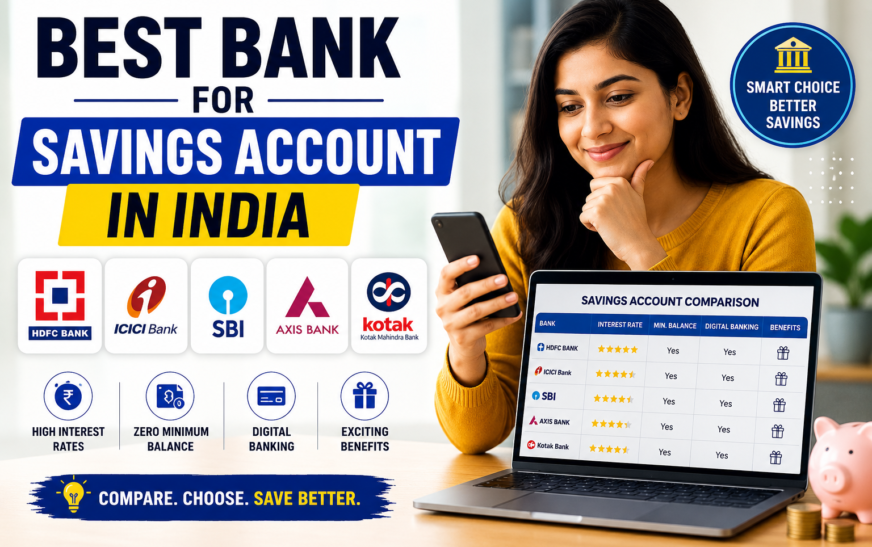
Looking for the best bank for savings account in India to grow your money safely and earn maximum interest? You are in the right place. With dozens of public sector banks, private banks, small finance banks, and digital banks competing for customers, finding the right one for your needs can be overwhelming.
The truth is, the best savings account in India is not just about the highest interest rate. It is about the right balance of returns, safety, digital banking experience, customer service, minimum balance rules, and added benefits like cashback, rewards, and insurance.
Savings account interest rates in India currently range from around 2.5 percent at large national banks to as high as 7 to 8 percent at select small finance banks and private banks. Your money should not just sit idle. It should be in a bank that actively rewards you for keeping it there.
In this complete guide, you will discover the top 10 banks for savings accounts in India, real interest rates, features, fees, and how to pick the best one for your financial goals. Let us dive in.
Why Choosing the Right Savings Account Matters
Before exploring the list, here is why your choice of savings bank account directly impacts your financial life.
Higher interest income. Even a 1 to 4 percent difference in interest rates can add up to thousands of rupees over time on larger balances.
Better digital experience. Modern banks offer instant transfers, UPI integration, free virtual debit cards, and intuitive mobile apps that save time.
Free perks. Many banks now offer cashback, lounge access, free insurance, lower charges, and exclusive offers on credit cards.
Safety and trust. Banks regulated by the Reserve Bank of India (RBI) offer DICGC deposit insurance up to 5 lakh rupees, protecting your money.
Easy access to other products. A good savings account opens doors to FDs, loans, mutual funds, and credit cards from the same trusted bank.
According to the DICGC website, all deposits in scheduled banks are insured up to 5 lakh rupees per depositor per bank, which is one of the strongest safety guarantees you can get on liquid funds.
Top 10 Best Banks for Savings Account in India
Here is a carefully curated list of the top 10 savings accounts in India, ranging from the highest interest paying banks to the most trusted public sector options.
1. IDFC First Bank Savings Account
IDFC First Bank is widely considered one of the best savings accounts in India because of its high interest rates, monthly interest credits, and zero charges on most services.
Interest rate: Up to 6.5 to 7 percent per annum based on the balance maintained.
Best for: Customers who want high interest with full liquidity and digital convenience.
Key features: Monthly interest payouts, free debit card, no charges on demand drafts, IMPS, NEFT, RTGS, and UPI.
2. AU Small Finance Bank Savings Account
AU Small Finance Bank consistently offers competitive savings account interest rates and a fully digital banking experience.
Interest rate: Up to around 7 percent per annum on higher balance tiers.
Best for: Digital savvy customers looking for higher returns and great mobile banking.
Key features: Premium debit cards, video KYC account opening, instant fund transfers, and lounge access on select cards.
3. RBL Bank Savings Account
RBL Bank offers a tiered interest rate structure, making it one of the best options for customers with larger balances.
Interest rate: Up to around 7.5 percent on certain high balance slabs.
Best for: Customers with bigger account balances looking for higher interest income.
Key features: Premium debit cards, partner offers, lounge access, and a strong mobile app.
4. DCB Bank Savings Account
DCB Bank offers some of the highest savings account interest rates in India through its tiered slab structure.
Interest rate: Up to around 8 percent on certain high balance slabs.
Best for: High net worth individuals and savers with substantial balances.
Key features: Competitive tiered rates, premium debit card benefits, and full digital banking.
5. Equitas Small Finance Bank Savings Account
Equitas Small Finance Bank is gaining popularity for offering attractive rates and modern banking features.
Interest rate: Up to 7 percent per annum.
Best for: Customers looking for higher interest rates with the safety of an RBI regulated bank.
Key features: Free debit card, unlimited ATM transactions, video KYC, and digital banking.
6. ICICI Bank Savings Account
ICICI Bank is one of India’s largest private banks, trusted by millions for its digital ecosystem and customer service.
Interest rate: Around 2.5 to 3 percent per annum based on the balance maintained.
Best for: Customers who want a strong digital experience and access to ICICI’s full financial ecosystem.
Key features: Industry leading iMobile Pay app, free virtual debit cards, instant FDs, and seamless integration with credit cards and investments.
7. HDFC Bank Savings Account
HDFC Bank is one of the most trusted private banks in India, with an extensive branch network and excellent service.
Interest rate: Around 2.5 to 3 percent per annum.
Best for: Customers who prioritize reliability, branch banking, and a comprehensive product range.
Key features: Over 14 savings account variants including women, senior citizens, and zero balance accounts. Strong mobile app and full digital banking.
8. State Bank of India (SBI) Savings Account
SBI is India’s largest and most trusted public sector bank, serving over 40 crore customers.
Interest rate: Around 2.5 percent per annum.
Best for: Customers who want the safety of government backing, widest branch network, and access to all banking services.
Key features: Multiple account types including Insta Plus Video KYC, basic BSBDA zero balance accounts, and special accounts for students, senior citizens, and minors.
9. Axis Bank Savings Account
Axis Bank is one of India’s top private banks, offering a wide range of digital and traditional savings account variants.
Interest rate: Around 2.5 to 3 percent per annum based on balance.
Best for: Customers seeking premium account features and digital banking innovations.
Key features: Multiple variants including ASAP Digital Savings Account, Liberty, Prestige, and Burgundy Premium accounts.
10. Kotak Mahindra Bank Savings Account (Kotak 811)
Kotak Mahindra Bank offers the popular Kotak 811 zero balance digital savings account, a favorite among younger customers.
Interest rate: Around 3 to 4 percent per annum.
Best for: Customers who want fully digital onboarding, zero balance accounts, and modern banking.
Key features: 100 percent digital account opening via video KYC, instant virtual debit card, full UPI integration, and seamless investing within the app.
How to Choose the Best Savings Account in India
With so many options, picking the right one can feel overwhelming. Use these factors to make the smartest decision.
Interest rate. Compare not just the headline rate but also the balance slab at which it applies. Some banks pay high rates only on certain balance ranges.
Minimum balance requirement. Some banks require Average Monthly Balance (AMB) of 5,000 to 25,000 rupees. Others offer zero balance accounts with full features.
Safety. Stick to RBI regulated banks. DICGC insures deposits up to 5 lakh rupees per depositor per bank.
Digital banking features. Check mobile app ratings, UPI integration, instant transfers, virtual debit cards, and customer service options.
Fees and charges. Watch for ATM withdrawal limits, cash deposit limits, debit card annual fees, and SMS alert charges.
Branch network. If you frequently visit branches or need cash deposit access, choose a bank with strong presence in your city.
Extra perks. Look for cashback, reward points, free insurance, airport lounge access, and partner offers that add real value.
Linked products. Banks that offer easy access to FDs, mutual funds, loans, and credit cards from the same account make life simpler.
Types of Savings Accounts in India
Indian banks offer multiple types of savings accounts to suit different customer needs.
Regular Savings Account. Standard accounts requiring an average monthly balance. Most flexible and feature rich.
Zero Balance Savings Account. No minimum balance required. Great for students, freelancers, and beginners.
Senior Citizen Savings Account. Special benefits for those above 60, including higher interest, free health insurance, and priority service.
Salary Account. Zero balance accounts opened by employers. Often come with premium features at no cost.
Women’s Savings Account. Special accounts with discounts, cashback, and added benefits tailored for women.
Minor Savings Account. Designed for children below 18 to teach savings habits early.
NRI Savings Account. NRE, NRO, and FCNR accounts for Non Resident Indians.
Digital Savings Account. Fully online accounts opened via video KYC with minimal paperwork. Examples include Kotak 811, ICICI iMobile, and SBI Insta Plus.
Best Zero Balance Savings Accounts in India
If you want to avoid minimum balance penalties, here are the top zero balance savings accounts.
- Kotak 811 Digital Savings Account
- SBI Basic Savings Bank Deposit Account (BSBDA)
- IndusInd Bank Indus Online Account
- HDFC Bank BSBDA
- RBL Bank Digital Savings Account
- Equitas Small Finance Bank Selfe Plus
- AU Small Finance Bank Digital Savings
These accounts offer most standard banking features with zero penalty for low balance.
Tips to Maximize Your Savings Account Returns
Smart strategy can dramatically boost your effective returns. Use these tips.
Park more money in higher rate banks. Move idle funds to small finance banks or high interest accounts like IDFC First, AU Small Finance, or RBL.
Use sweep in FDs. Many banks automatically convert excess savings into short term FDs for higher returns while keeping liquidity.
Track interest tiers. Some banks pay higher interest only on incremental balances above certain slabs. Plan your deposits accordingly.
Avoid maintenance penalties. Always maintain the required average monthly balance to avoid fees that eat into your earnings.
Choose quarterly compounding. RBI now mandates banks to credit interest quarterly. Confirm with your bank for the best frequency.
Use the right account for the right purpose. Keep emergency funds in high interest savings accounts, daily expenses in convenient digital accounts, and long term goals in FDs and investments.
For long term financial growth, pair your savings strategy with our 15 personal finance tips to make smarter money decisions.
Common Mistakes to Avoid
Avoid these traps that quietly cost most account holders thousands of rupees.
Ignoring minimum balance rules. Penalty charges can wipe out months of interest earnings.
Not using sweep facility. Excess money sitting in savings accounts at 2.5 percent is losing value. Use sweep FDs or short term deposits.
Holding multiple unused accounts. Extra accounts mean extra balance requirements, fees, and confusion. Close inactive accounts.
Ignoring digital banks. Many digital and small finance banks offer 2 to 3 times higher interest than traditional banks. Explore them.
Forgetting DICGC limits. Deposits over 5 lakh rupees in a single bank are not fully insured. Split across banks for full safety.
Falling for hidden fees. Always read the schedule of charges before opening an account. Hidden ATM, SMS, and debit card fees add up.
Savings Account vs Fixed Deposit: Which Is Better?
This is one of the most common questions, and the answer depends on your goals.
Savings Account: Best for liquidity, daily expenses, emergency funds, and any money you might need in the short term. Interest rates are typically 2.5 to 7 percent.
Fixed Deposit (FD): Best for surplus funds you do not need for months or years. Locks money in but offers higher guaranteed returns of 6 to 8.5 percent.
The smart strategy is to keep 3 to 6 months of expenses in a high interest savings account for emergencies, and the rest in FDs or other investments. Learn more in our complete guide on banks that give higher interest rate in India.
Savings Account vs Other Investment Options
While savings accounts are perfect for liquidity, they should not be your only place to keep money.
Liquid Mutual Funds: Offer slightly higher returns of around 6 to 7 percent with similar liquidity. Great for parking surplus funds.
Sweep in FDs: Automatic conversion of excess savings into FDs for higher returns without losing liquidity.
RBI Floating Rate Bonds: Around 8 percent semi annual interest, government backed. Available through the RBI Retail Direct portal.
PPF (Public Provident Fund): Tax free returns of around 7 to 7.5 percent with a 15 year lock in. Great for long term savings.
For more wealth building strategies, also check our guide on passive income ideas that actually work to diversify beyond savings.
How Much Interest Can You Earn From a Savings Account?
Let us look at realistic scenarios for a savings account balance of 1 lakh rupees over one year.
At 2.5 percent (SBI, HDFC, ICICI standard rates), you earn around 2,500 rupees per year.
At 4 percent (Kotak 811, mid tier accounts), you earn around 4,000 rupees per year.
At 6 to 7 percent (IDFC First Bank, AU Small Finance), you earn 6,000 to 7,000 rupees per year.
At 7 to 8 percent (RBL Bank, DCB Bank, Equitas SFB high balance slabs), you earn 7,000 to 8,000 rupees per year.
Over a 10 year period on a 5 lakh rupee balance, the difference between 2.5 percent and 7 percent compounds to over 1.5 lakh rupees in extra earnings. Choosing the right bank truly matters.
Frequently Asked Questions (FAQs)
Which is the best bank for savings account in India?
The best bank for savings account in India depends on your priorities. For the highest interest rates, small finance banks like AU, Equitas, Ujjivan, and Suryoday Small Finance Bank along with IDFC First Bank and RBL Bank lead the list. For safety and reliability, SBI, HDFC Bank, and ICICI Bank remain top choices. For digital banking, Kotak 811, IDFC First, and ICICI iMobile are excellent.
Which bank gives the highest interest rate on savings account in India?
Currently, banks like DCB Bank, RBL Bank, AU Small Finance Bank, Equitas Small Finance Bank, and IDFC First Bank offer the highest savings account interest rates in India, ranging from 6.5 to 8 percent per annum based on balance tiers. Always check the latest slab structure on the bank’s official website.
Are small finance banks safe for savings accounts?
Yes, small finance banks are safe because they are regulated by the Reserve Bank of India (RBI) and deposits up to 5 lakh rupees per depositor per bank are insured under DICGC. For larger amounts, split your money across multiple banks for complete protection.
What is the minimum balance for a savings account in India?
Minimum balance requirements vary widely. Public sector banks like SBI may require as little as 0 to 3,000 rupees. Private banks like HDFC, ICICI, and Axis typically require 5,000 to 25,000 rupees. Zero balance accounts like Kotak 811 and SBI BSBDA require no minimum balance at all.
Is savings account interest taxable in India?
Yes. Savings account interest is taxable as “Income from Other Sources.” However, individuals can claim a deduction of up to 10,000 rupees per year under Section 80TTA (or 50,000 rupees for senior citizens under Section 80TTB). For full details, visit the Income Tax Department of India website.
How is savings account interest calculated in India?
As per RBI guidelines, savings account interest in India is calculated on a daily basis based on the closing balance. The accumulated interest is then credited quarterly or half yearly depending on the bank’s policy. Most banks now credit interest quarterly.
Can I open a savings account online in India?
Yes. Most major banks now offer fully online account opening through video KYC. You can open accounts like Kotak 811, SBI Insta Plus, ICICI iMobile Pay, HDFC InstaAccount, and IDFC First Bank online within minutes using your Aadhaar and PAN.
What is a zero balance savings account?
A zero balance savings account does not require you to maintain any minimum balance. There are no penalties even if your balance falls to zero. Popular options include Kotak 811, SBI BSBDA, RBL Digital, IndusInd Online, and AU Small Finance Bank Digital Savings.
What is the difference between savings account and current account?
A savings account is meant for individuals to save money and earn interest. It has limits on monthly withdrawals. A current account is meant for businesses with unlimited transactions but offers little to no interest. Use savings for personal finance and current accounts for business operations.
How safe is keeping money in a savings account in India?
Money in savings accounts of scheduled banks in India is very safe. The Reserve Bank of India regulates all banks, and DICGC insures deposits up to 5 lakh rupees per depositor per bank. For larger amounts, splitting funds across multiple banks ensures full protection.
Final Thoughts
Choosing the best bank for savings account in India is one of the simplest yet most impactful financial decisions you can make. The right account does not just hold your money safely. It also earns you better returns, gives you a smooth digital experience, and unlocks valuable perks that make everyday banking easier.
Whether you prioritize the highest interest rates from banks like IDFC First, AU Small Finance, or RBL Bank, or you prefer the rock solid trust of SBI, HDFC, and ICICI, the key is to match the account to your needs. Compare interest rates, fees, digital features, and customer service before opening an account, and do not hesitate to switch if a better option becomes available.
For most people, the ideal strategy is to use multiple accounts. Keep daily expenses in a convenient zero balance digital account, emergency funds in a high interest savings account, and long term wealth in FDs and investments.
If you want to take your savings to the next level, also explore our guides on banks that give higher interest rate in India, passive income ideas that actually work, and 15 personal finance tips to build long term wealth.
Which bank are you choosing for your savings account? Pick the one that best matches your goals, take action today, and share your experience in the comments below.
Disclaimer: Interest rates and account features mentioned in this article are based on the most recent publicly available data at the time of writing and may change without notice. Always verify the latest rates and terms directly from official bank websites or visit the RBI website before opening an account. This article is for informational purposes only and does not constitute financial advice.











9 Comments
[…] For a complete comparison of regular savings accounts, check our detailed guide on the best bank for savings account in India. […]
[…] for: Safe day to day savings with full liquidity. Compare it with our complete guide on the best bank for savings account in India to choose between […]
[…] funds, and short term goals. If you want to maximize interest, check our complete guide on the best bank for savings account in India to find the highest paying […]
[…] you want to compare with private bank savings accounts, check our complete guide on the best bank for savings account in India for higher interest […]
[…] For the highest paying savings accounts, check our complete guide on the best bank for savings account in India. […]
[…] For the highest paying savings accounts available, check our complete guide on the best bank for savings account. […]
[…] This fund gives you breathing room for legal fees, moving costs, deposits, and unexpected expenses during the transition. For top options, see our guide on the best bank for savings account. […]
[…] Build your down payment using dedicated savings or short term investments. For top high interest savings options, see our guide on the best bank for savings account. […]
[…] For top high interest savings options, see our complete guide on the best bank for savings account. […]